
26 November 2026
171 Billion: Abu Dhabi Was the Quiet One
AED 171.26 billion in nine months. Numbers that size are rarely an accident.
I sell property in Dubai. So what follows runs against my most obvious interest.
For years, when a client asked me about Abu Dhabi, the market gave the same answer. It is the capital, it is institutional, it is quiet. Quiet was said in a tone that meant slow. That reading no longer survives contact with the data.
In the first nine months of 2026, AED 171.26 billion of property changed hands in Abu Dhabi, roughly US$46.6 billion, across 38,483 transactions. Value is up 76.1% on the same period of 2025, volume up 32.8%. The figures come from the Abu Dhabi Real Estate Centre, the emirate's property authority.
Value grew more than twice as fast as the number of deals. That is the first thing to read properly. People are not only buying more, they are buying higher.
What sits inside that number
Direct sales account for AED 119.33 billion across 23,749 transactions, up 105% in value and 49.2% in volume on the first nine months of 2025. Mortgages account for AED 45.92 billion across 14,390 transactions, up 30.2% in value but only 13.2% in volume. Musataha and long lease agreements: 268 deals worth AED 5.57 billion. Gift transactions, meaning transfers inside a family, number 76 and are worth AED 440 million, with value up 389%.
The four lines add up to exactly the headline, AED 171.26 billion. That is not a given. Plenty of market numbers in circulation do not reconcile, and nobody can tell you what is inside them.
The mortgage line deserves an extra sentence. Value grew more than twice as fast as the number of cases. That means larger average tickets, not more buyers taking on debt. It is the behaviour of a market moving up a tier, not one leveraging up.
And that 389% on gifts makes very little noise but says a lot. Families who live here have started settling succession before it becomes a problem.
Four islands doing more than half the work
Roughly AED 90.57 billion, more than half the market, sits on four pieces of land. Each absorbs a different kind of buyer.
Al Reem Island, AED 29.86 billion. The ADGM financial corridor expanding outward, with yield-driven residential stock behind it.
Al Hudayriyat Island, AED 28.62 billion. Coastal villas and sports-lifestyle masterplans at the top of the market.
Saadiyat Island, AED 18.69 billion. The cultural district, and a beachfront that cannot be extended.
Yas Island, AED 13.40 billion. Entertainment and tourism, now anchored by branded waterfront residences.
Zayed City follows with AED 5.36 billion.
This concentration is not a fashion. In Abu Dhabi, foreign buyers can own freehold only inside designated investment zones, under Law No. 13 of 2019, which amended Law No. 19 of 2005. The map of what gets bought is, first of all, a map of the law.
Who is buying
Inside the investment zones, foreign investment reached AED 86.11 billion, up 131%, and accounts for 81% of all investment value in those areas.
The share coming from non-resident individuals is AED 17.22 billion, more than double the AED 8.2 billion recorded across the whole of 2025. Investors from 121 nationalities took part. By value, the leading sources are the United Kingdom, China, Russia, the United States, France and Germany.
In the same year Abu Dhabi rose from 41st to 33rd in JLL's Global Real Estate Transparency Index, with a score of 2.42, moving from the Semi-Transparent tier into the Transparent one. It was the most improved market in the world in that survey, and it ranks second across MENA. JLL credits the jump to open data: transactions visible at unit level, interactive maps, published service charges, open APIs.
Those two facts belong together. Investors who once needed a local introduction to feel comfortable here are now simply reading the rulebook and buying.
Why the foundations hold
The part that rarely makes the headlines is who is actually building.
Modon is controlled by L'imad, a holding company belonging to the Abu Dhabi Government, and is behind the masterplans on Hudayriyat and Reem. Aldar's top two shareholders are Alpha Dhabi and Mubadala, and it is working directly with the Department of Municipalities and Transport on five new communities covering more than 20 million square metres. Imkan sits inside Abu Dhabi Capital Group. Taraf was launched by Yas Holding and is delivering the branded residences on Yas Island. Al Ain Properties sits inside Al Ain Holding and is building on Al Maryah.
The chart below lays the ownership out. It starts with His Highness Sheikh Mohamed bin Zayed, President of the United Arab Emirates and Ruler of Abu Dhabi, and runs down to the companies putting cranes on the ground today.
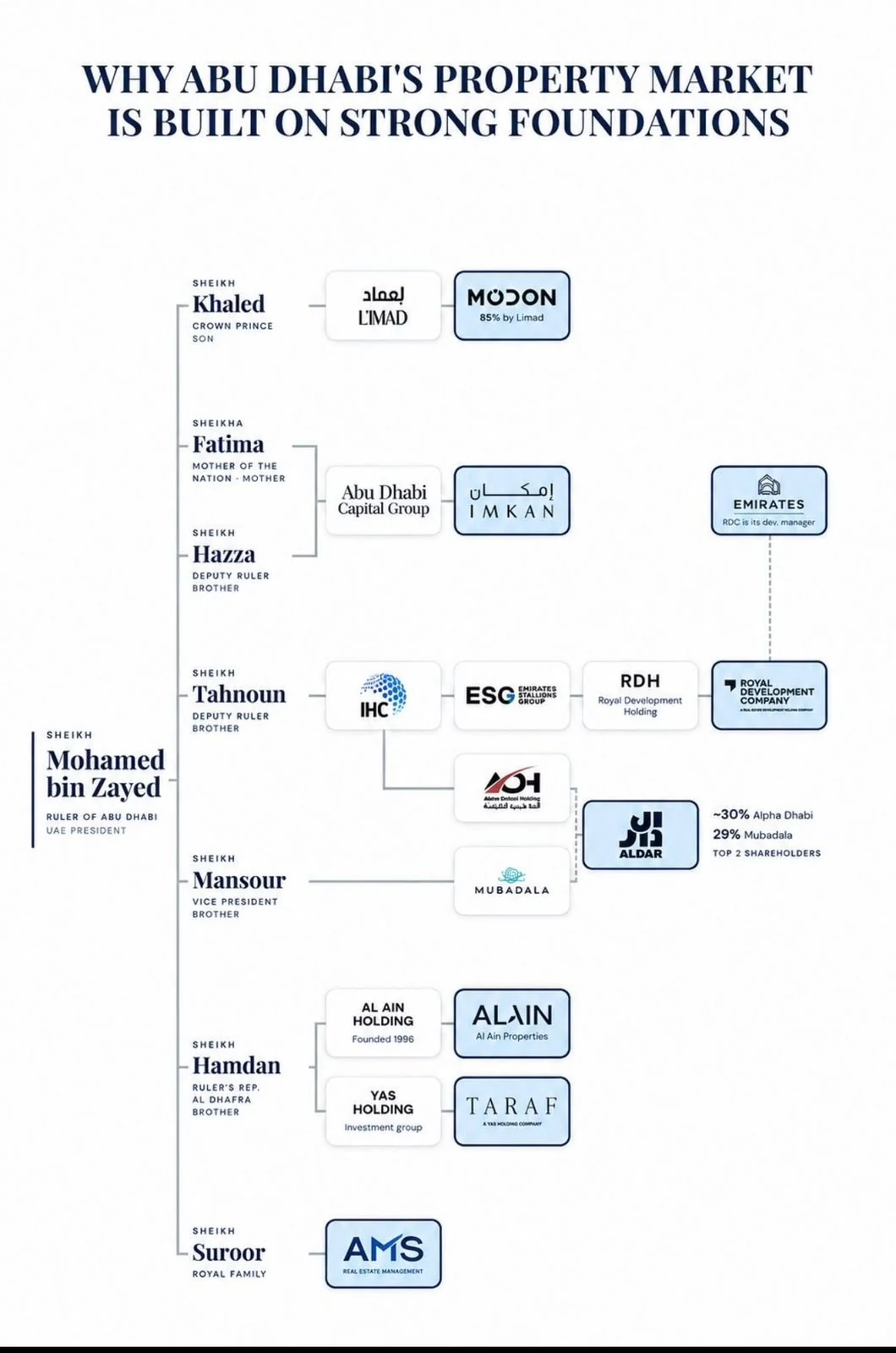
These are not developers who need the next launch to fund the last one. When you buy off-plan, that is the difference that matters, and it is usually the one question nobody asks.
A faster private layer has formed around that spine, including Ohana, Eagle Hills, Emirates Developments and SAAS. But the spine is institutional, and that is the real argument for Abu Dhabi.
What this article does not say
It does not say Abu Dhabi is better than Dubai. It says Abu Dhabi has become a serious choice, and that two years ago it was not one in the same way.
It remains a smaller market, and it resells more slowly. Anyone buying here should price in a longer horizon and fewer buyers on the way out.
Then there is supply. Over the nine months, 54 new development projects were registered and 3,677 professional licences issued, 32% more than last year. Six districts, Saadiyat, Reem, Yas, Zayed City, Khalifa City and Hudayriyat, are projected to absorb 77% of incremental supply through 2030. When that supply lands, today's numbers will need reading again.
Saying it now costs very little. Finding it out in three years costs a lot.
Why I wrote this
A client never asks me which emirate suits me to sell. They ask where to put the next ten years of their money.
For years the honest answer on Abu Dhabi was that it was solid but slow, and the market was thin. That sentence is now eighteen months out of date, and the Real Estate Centre's own figures contradict it line by line.
Anyone who sells one emirate will always give you the same answer. I would rather give you the numbers and let you choose.
Data: Abu Dhabi Real Estate Centre (ADREC), first nine months of 2026; JLL Global Real Estate Transparency Index 2026.