
Nov 15
Emirati Generosity? He Was Wrong!
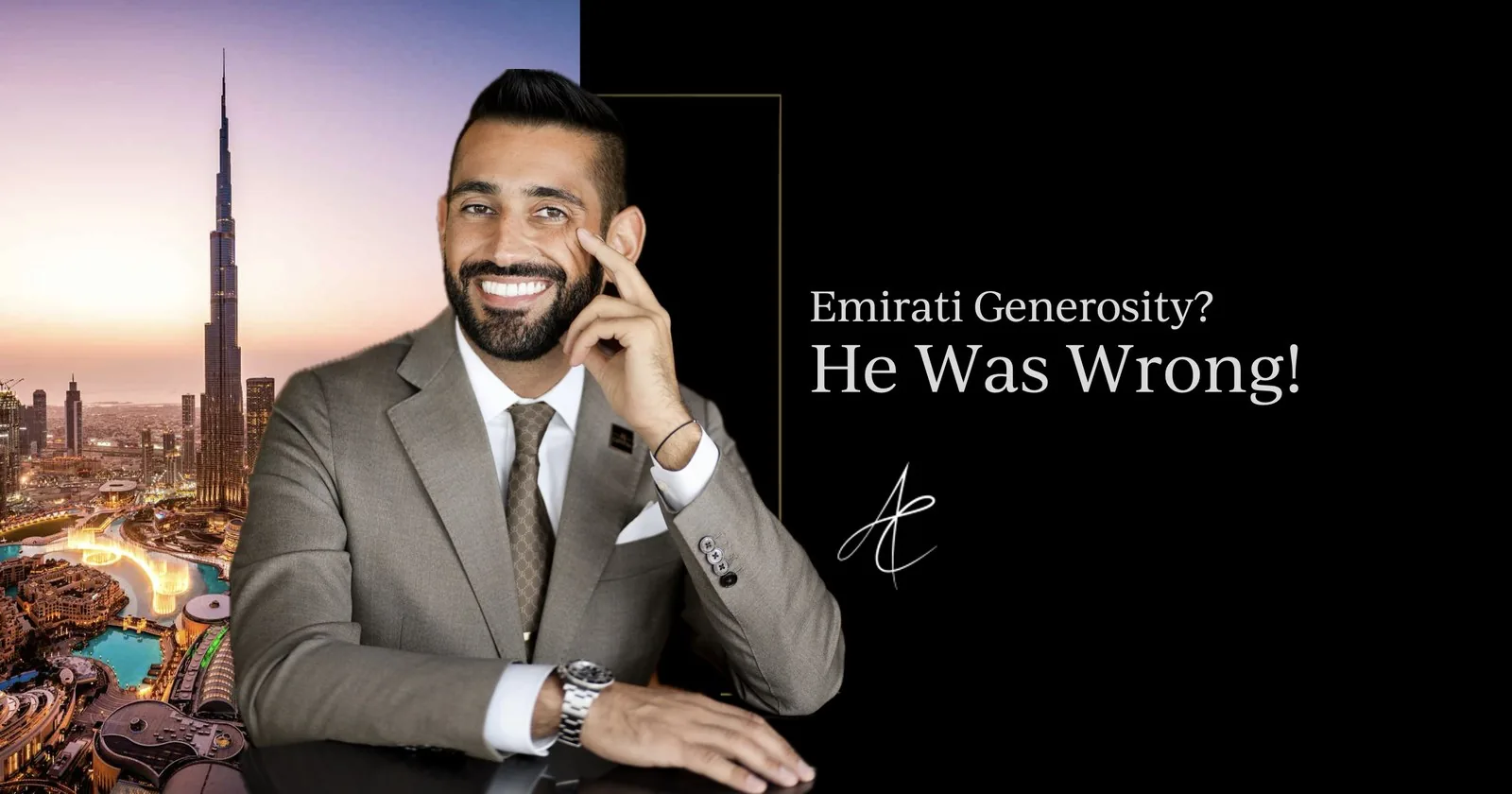
A question in New York, and the numbers I went to find.
This summer I was in New York, at a gathering of investors and people from my industry.
We were talking about safety. I had said that in Dubai you can walk anywhere, at any hour, and that begging on the street is a crime here and is prosecuted. An American gentleman picked that up and turned it around. If you never see poor people on the street, he asked, is that because the problem does not exist, or because you keep it out of the frame? And then the real question: what does that country actually do for people in need?
The room was looking at him. It was a fair question, well put.
I answered with what I knew. That the Emirates give a great deal. That the ruling family funds health programmes across half the world out of their own pockets. That begging is illegal here, but that street homelessness does not exist, and that those are two different facts. Then I said the only honest thing available to me at that moment: I did not have the exact figures in my head.
I told him I would come back with the numbers. This article is the numbers.
What the country gives
In 2025 the United Arab Emirates was the third largest humanitarian donor in the world, with US$1.46 billion. Only the United States and the European Union gave more. That is 7.2% of all aid recorded by the United Nations, from a country of roughly ten million people.
Since 1971, Emirati foreign aid has passed US$100 billion. The OECD consistently places the UAE among the largest providers of development assistance relative to national income.
A few recent lines, so we know what we are talking about. More than AED 9.4 billion in assistance to Gaza, including over 100,000 tons of supplies, field hospitals and floating hospitals that have treated more than 75,000 patients. US$4.24 billion to Sudan over the past decade. 700 tons of food to Somalia. More than 1,000 tons to Chad for 150,000 flood victims. A US$20 million eye hospital in Uganda. A US$64.5 million grant to Al Makassed Hospital in East Jerusalem.
There is a principle behind it, and it is written down. Emirati aid is not conditioned on the geography, race, colour or religion of the person receiving it. His Highness Sheikh Zayed bin Sultan Al Nahyan, the founding father, set that rule, and nobody has changed it since.
Who signs the cheques
This is the part almost nobody abroad knows, and to me it is the part that actually answers the question I was asked in New York. It is not only the state that gives. It is the people who run it, from their own wealth.
His Highness Sheikh Mohamed bin Zayed, President of the UAE, has personally committed US$525 million since 2011 to polio eradication. Those funds helped reach more than 400 million children. Bill Gates, who has no reason to flatter anyone on this subject, called the partnership decisive.
In December 2025 Abu Dhabi hosted the "Investing in Humanity: United to End Polio" summit and mobilised US$1.9 billion in pledges. It was the third such summit in the capital. The two before it, in 2013 and 2019, raised US$6.6 billion between them.
His Highness Sheikh Mohamed bin Zayed also launched the Reaching the Last Mile Fund, around US$500 million to eliminate river blindness and lymphatic filariasis in Africa: more than 100 million treatments delivered and 1.3 million health workers trained. In 2024 came the Zayed Humanitarian Legacy Initiative, AED 20 billion for the world's most vulnerable communities. Through the Emirates Polio Programme, roughly 667.5 million vaccine doses were delivered in Pakistan between 2014 and 2022, reaching 17 million children in hard to access areas, including the first polio campaign anywhere in the world after the Covid outbreak.
In Dubai, His Highness Sheikh Mohammed bin Rashid Al Maktoum personally donated the funds for 400 million meals, the meals still missing to complete the "1 Billion Meals" campaign in 2022. He then contributed personal real estate assets and monetary donations to the endowment behind the same initiative, which raised a record AED 1.075 billion.
His foundation, MBRGI, is the largest philanthropic organisation in the region. In 2025 alone it spent AED 2.3 billion, reaching 165 million people in 122 countries, backed by endowments worth more than AED 7 billion. The billion meals were completed in July 2025, distributed across 65 countries.
And here is something that tells you how this place works. There are national fundraising campaigns named after family members, and people take part. The Fathers' Endowment raised AED 3.72 billion, almost four times its target, from more than 277,000 contributors, for medical care in communities that cannot afford it. Before that came the Mothers' Endowment, AED 770 million in its first two weeks, for education. In November 2025 the Mohammed bin Rashid Humanitarian Ship set off with more than 10 million meals for Gaza.
What it does for the people who live here
In New York the question was about helping others. But there is a second half to the answer, and it concerns anyone who arrives here with talent and no capital.
Dubai and Abu Dhabi grant ten year Golden Visas to artists, designers, filmmakers, writers, musicians, photographers and content creators. Self sponsored residency, granted on creative merit, family included. Very few countries in the world offer long term residency on the strength of artistic talent alone. Abu Dhabi adds a dedicated Creative Visa, endorsed by the Department of Culture and Tourism, covering heritage, performing arts, visual arts, design and crafts, gaming and e sports, media and publishing.
Around it sits the infrastructure: Louvre Abu Dhabi, the Saadiyat Cultural District, Alserkal Avenue, Art Dubai, SIKKA. These are not showcases. They are the places where an emerging artist exhibits, sells and finds a patron.
For anyone who wants to start a business instead: the Khalifa Fund offers interest free microfinance covering up to 80% of project costs, up to AED 1 million. The Dubai SME Fund provides interest free seed capital between AED 1 million and AED 3 million and takes no equity. Alongside them sit Sheraa in Sharjah, RUWAD, the Mohammed Bin Rashid Innovation Fund and Emirates Development Bank.
And it starts remarkably early. The Future Entrepreneur Programme is aimed at innovators aged 4 to 18. The Game Incubator takes on young people aged 18 to 25.
Back to the beggars
On the question that started all of this I owe a clarification, because the easy answer would have been to say there is no poverty here. That is not true and it would not be credible.
Begging exists, and it is a crime. During Ramadan and Eid in 2025, Dubai Police arrested 222 people for begging, many of whom had entered the country on a tourist visa for that season. The city treats it as an organised business rather than individual desperation, and prosecutes it.
What genuinely does not exist here is street homelessness. In New York, at recent peaks, more than 100,000 people slept in shelters or on the street. In Dubai and Abu Dhabi, people living on the street are, in practice, absent.
There is also a redistribution that nobody sees, because it does not arrive as a benefit payment. There is no income tax here. Someone on a low wage keeps 100% of their salary. In New York, a person on a modest income loses roughly 25% to 30% to combined federal, state and city taxes.
The difference that matters
In the end the difference between the two models is philosophical, and it is worth saying plainly.
New York manages poverty after it happens, with shelters, benefits and a very large welfare bureaucracy, and it guarantees a legal right to shelter to anyone. That is a serious choice and it has its own dignity.
The Emirates try to prevent it first: no income tax, interest free capital for people willing to try, ten year residency for people with talent, and state philanthropy that is a function of government rather than an afterthought.
You can argue about which one works better. You cannot say the second one does nothing.
Why I wrote this
I sell property in Dubai. I do not sell passports and I do not sell ideology. But people who buy a home here are not only buying a yield. They are buying a place where, sooner or later, they will put their children in school, open a bank account, live a life.
A client does not only ask you what it returns. At some point they ask you what kind of place this is. And on that day, the difference between an answer and an opinion is the numbers.
Now I have them.